Cross-border AI visibility study 2026
Chapters

Original study, October 2026

Does your authority cross the border?

The same question, asked in French, German and English from France, Germany and Switzerland. This is what Google AI Overviews, ChatGPT and Perplexity cite.

1,510 answers analysed, 12,414 links cited. Collected 25 September to 2 October 2026, logged out, with a VPN set to Paris, Frankfurt and Zurich.

Who are you? See what to watch first.

Three questions about your business. The findings and recommendations reorder themselves to fit you. The sorting happens in your browser: nothing is sent.

Where do you sell?
In which languages does your site exist?
What do you sell?

Tick at least one answer: your three points to watch appear here.

To watch first, for you

    Seven findings

    Four findings hold in both sectors, three are specific to one. Each gives its question, its result with its base, how to read it and its caveats.

    • Finding The result holds in both sectors and rests on stable citations.
    • Vertical-specific The result holds for one sector, cookware or B2B. It is not generalised to the other.

    Row: same language, three countries. Column: same country, three languages.

    FindingFor you

    Language decides the sources, more than country

    When the country or the language changes, do the cited sources change?

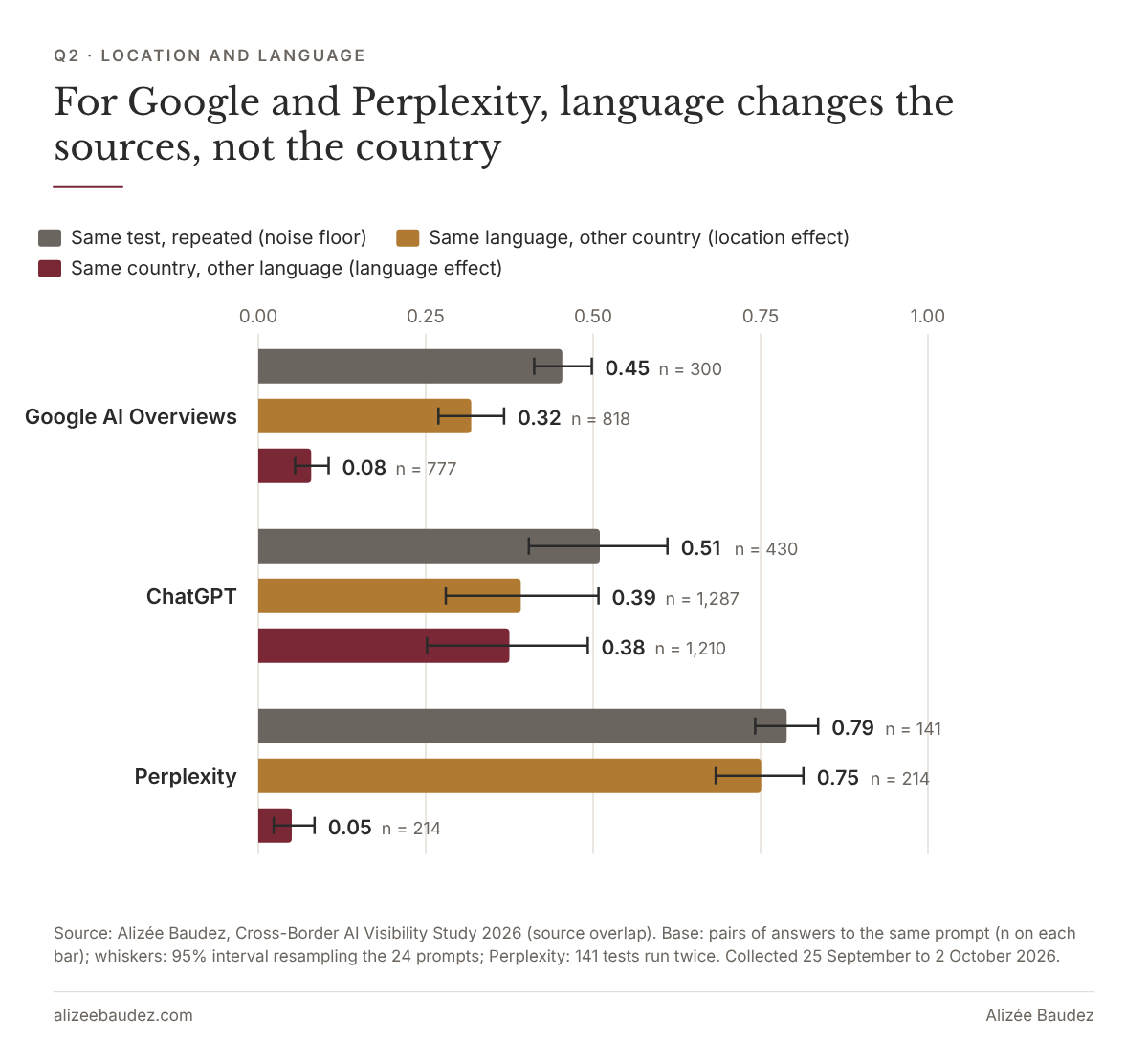
    Overlap is 1 when two answers cite the same sites and 0 when they share none. On Google, two answers in the same language from two countries share 0.32 of their sites. From the same country in two languages, 0.08. On Perplexity, 0.75 against 0.05. ChatGPT is the exception: 0.39 across countries, 0.38 across languages. There, country counts as much as language.

    Try it: what does your set-up share with the other eight?

    Each cell is a set-up: a question language (row) asked from a country (column). The number is the share of cited sites that set-up has in common with the ringed cell. 1 means the same sites, 0 means no site in common.

    Same language, other country (location effect)Same country, other language (language effect)Country and language both changeStarting cell: the same test, repeated (noise floor)

    Try this: stay on Google, then compare the cell to the right of the ringed one (same language, other country) with the one below it (same country, other language). Click any cell to make it the starting point.

    On Google and Perplexity, language changes the sources, country does not

    Source: Alizée Baudez, Cross-Border AI Visibility Study 2026 (overlap of sources). Base: pairs of answers to the same question (n on each bar); whiskers: 95% interval, resampling the 24 questions; Perplexity: 141 tests run twice. Collected 25 September to 2 October 2026.
    See the chart data
    SectorToolSame test, repeatedSame language, other countrySame country, other languagen (same language, other country)n (same country, other language)
    Both sectorsGoogle AI Overviews0.450.320.08818777
    Both sectorsChatGPT0.510.390.381,2871,210
    Both sectorsPerplexity0.790.750.05214214
    Cookware (B2C)Google AI Overviews0.540.390.11299304
    Cookware (B2C)ChatGPT0.390.250.19550505
    Cookware (B2C)Perplexity0.800.760.01106106
    B2B (components)Google AI Overviews0.400.280.06519473
    B2B (components)ChatGPT0.600.500.51737705
    B2B (components)Perplexity0.780.740.08108108

    Reading. On Google and Perplexity, the German version of your site is not a translation of the French one. It is a presence on another market, facing other sources. At domain level, 56% of the 603 domains Perplexity cites appear in all three countries, against 15% of the 327 domains Google cites stably.

    Caveat. Bases: 818 and 777 pairs of Google answers (location, then language), 214 and 214 for Perplexity. The gap "location minus language" is positive on Google (0.199 to 0.276) and on Perplexity (0.637 to 0.763), and includes zero on ChatGPT (−0.041 to 0.079). 24 questions, two sectors, one week.
    All cells, English row included: the country of the test counts even without a local language.

    FindingFor you

    ChatGPT assumes the country you are writing from

    Do the tools localise their sources by the country of the test?

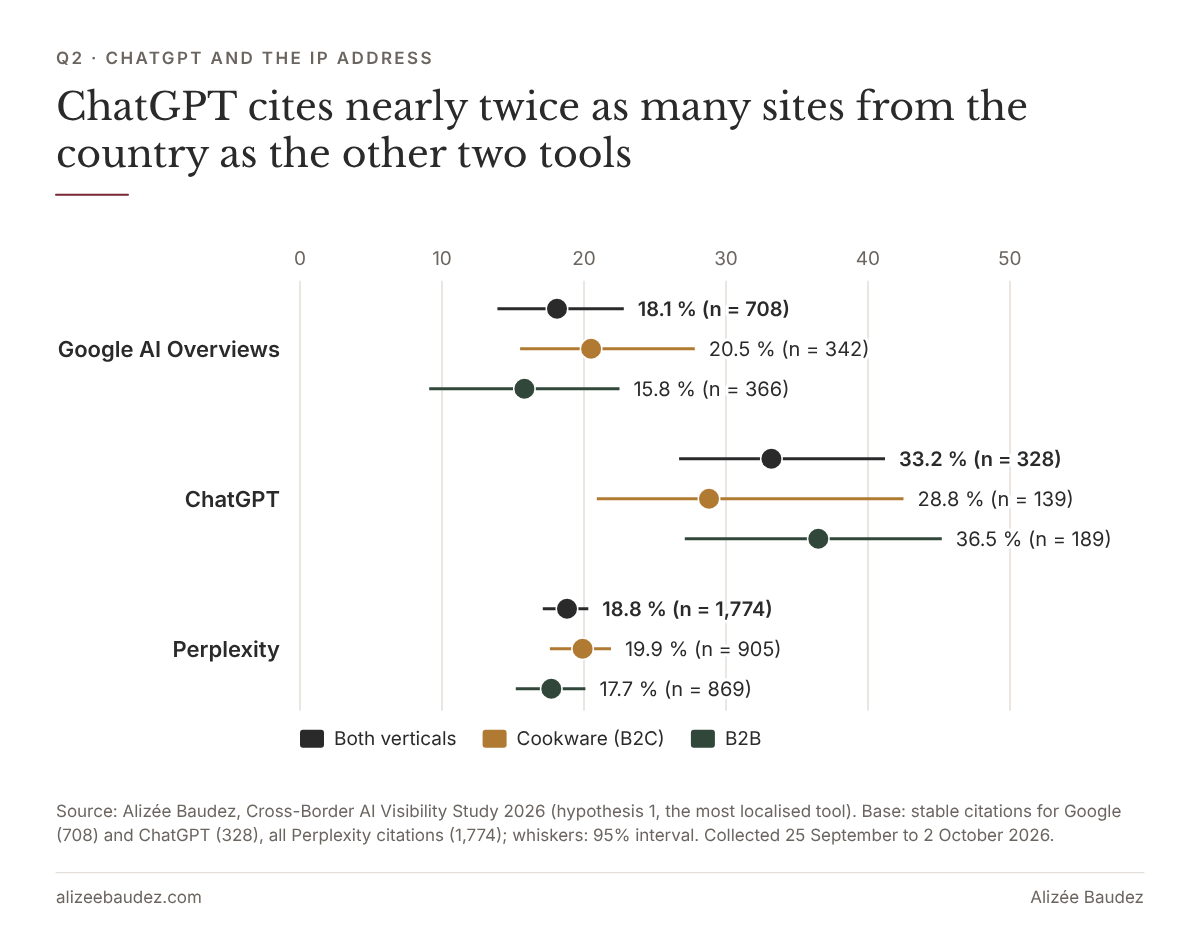
    ChatGPT cites 33.2% sites from the tested country, Google 18.1%, Perplexity 18.8%. Even in English, ChatGPT stays anchored: 26.7% tested-country sites, against 6.4% and 2.1%. On three questions that do not say where you are, ChatGPT takes the country of the test for the person’s own in 52 of 81 answers, Google in 19 of 67, Perplexity in 5 of 27.

    ChatGPT cites nearly twice as many sites from the country as the other two tools

    Source: Alizée Baudez, Cross-Border AI Visibility Study 2026 (hypothesis 1, the most localised tool; country assumed by the answer). Base: stable citations for Google (708) and ChatGPT (328), all citations for Perplexity (1,774); whiskers: 95% interval. Assumed country: answers to the three questions where the person’s country matters (CW12, EA03, EA12). Collected 25 September to 2 October 2026.
    See the chart data
    ToolBoth sectorsCookware (B2C)B2BEnglish answersTest country taken for the person’s own
    Google AI Overviews18.1%20.5%15.8%6.4%19 / 67
    ChatGPT33.2%28.8%36.5%26.7%52 / 81
    Perplexity18.8%19.9%17.7%2.1%5 / 27

    Reading. A company that sells in both France and Germany cannot read a test run from a single country, even in English.

    Caveat. Each country was collected on a different day: the effect of the country and the effect of the day cannot be separated. The mechanism (IP address or otherwise) is not observed, only the effect is. Bases: 328 stable ChatGPT citations, 708 Google, 1,774 Perplexity citations.

    Swiss column: answers obtained from Zurich, in French and in German.

    FindingFor you

    From Zurich, answers cite the neighbouring countries first

    From Zurich, do answers cite Swiss sites or those of the neighbouring countries?

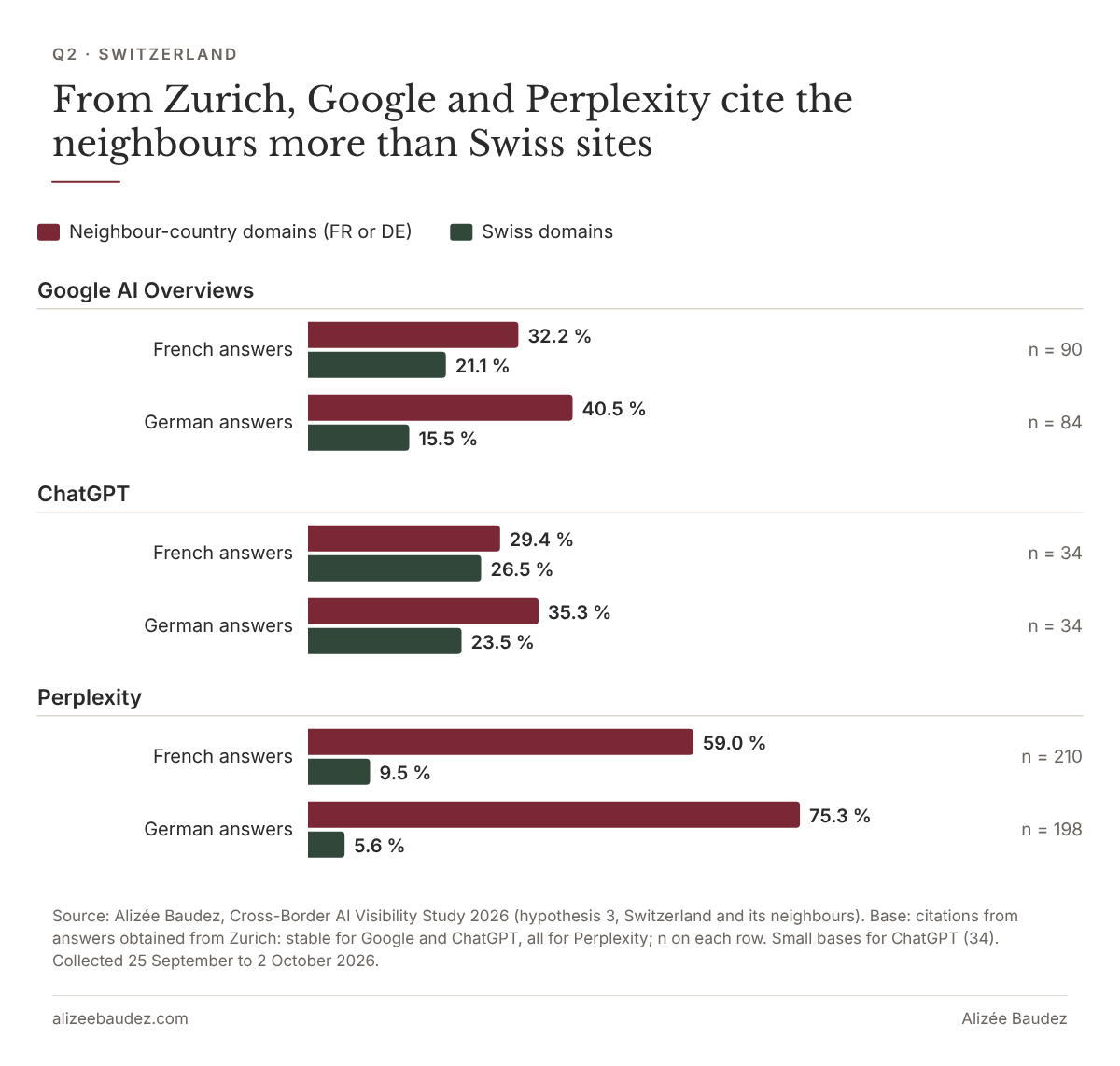
    From Zurich, in German, Perplexity cites 75.3% German domains against 5.6% Swiss ones (198 citations). In French, 59.0% French domains against 9.5%. Google points the same way: 40.5% against 15.5% in German, 32.2% against 21.1% in French. ChatGPT is closer to balance, but its base is narrow (34 stable citations).

    From Zurich, Google and Perplexity cite neighbours more than Swiss sites

    Source: Alizée Baudez, Cross-Border AI Visibility Study 2026 (hypothesis 3, Switzerland and its neighbours). Base: citations in answers obtained from Zurich, stable for Google and ChatGPT, all for Perplexity; n on each line. An asterisk marks a base of fewer than 30 citations. Collected 25 September to 2 October 2026.
    See the chart data
    SectorToolAnswers in French: french domainsAnswers in French: swiss domainsAnswers in German: german domainsAnswers in German: swiss domainsn
    Both sectorsGoogle AI Overviews32.2%21.1%40.5%15.5%90 / 84
    Both sectorsChatGPT29.4%26.5%35.3%23.5%34 / 34
    Both sectorsPerplexity59.0%9.5%75.3%5.6%210 / 198
    Cookware (B2C)Google AI Overviews36.4%29.5%43.9%24.4%44 / 41
    Cookware (B2C)ChatGPT31.2%25.0%20.0%20.0%16 / 15
    Cookware (B2C)Perplexity61.9%10.5%84.3%4.9%105 / 102
    B2B (components)Google AI Overviews28.3%13.0%37.2%7.0%46 / 43
    B2B (components)ChatGPT27.8%27.8%47.4%26.3%18 / 19
    B2B (components)Perplexity56.2%8.6%65.6%6.2%105 / 96

    Reading. A Swiss reader gets answers built on the ecosystem of the neighbouring country that speaks their language. On Google and Perplexity, authority earned in that country counts for more than authority earned in Switzerland. That does not make Swiss sites poorly adapted.

    Caveat. Zurich stands for all of Switzerland; Geneva or Lausanne might give something else. Bases: 34 to 210 citations depending on the tool. The direction is the same in both sectors for Google and Perplexity; ChatGPT ties in two of the four sector splits.

    All cells: the result covers all answers.

    Vertical-specificFor you

    Authority depends on the sector before it depends on the tool

    Which types of site does each tool cite, by sector?

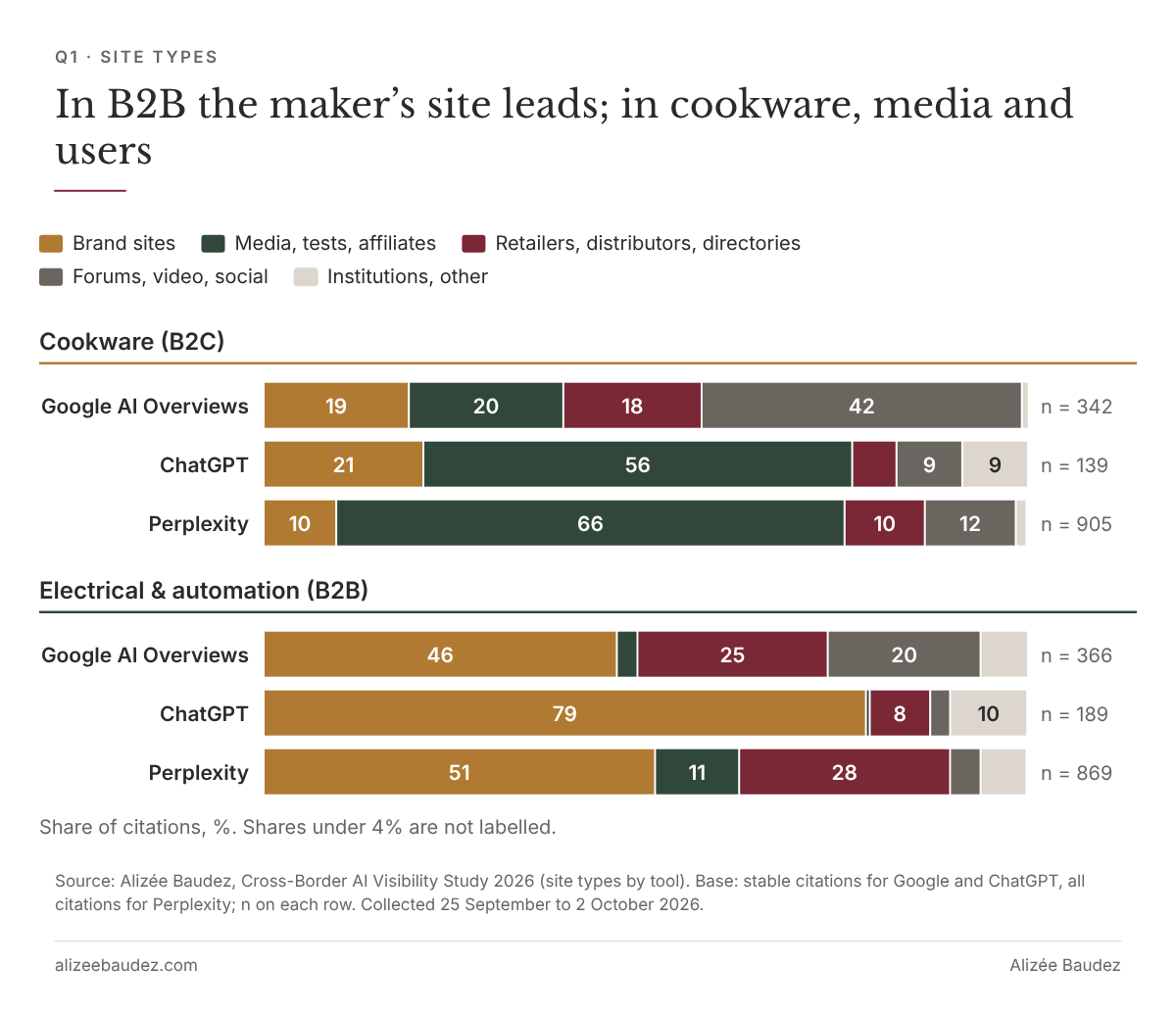
    In B2B, the manufacturer’s site is the first source: 78.8% of ChatGPT’s stable citations, 46.2% of Google’s, 51.2% of Perplexity’s citations. In cookware, the same share falls to 20.9%, 19.0% and 9.5%. When a site exists in several country versions, the version for the tested country is the exception: 24% of links on Google, 26% on ChatGPT, 22% on Perplexity.

    In B2B, the manufacturer’s site dominates; in cookware, media and users

    Source: Alizée Baudez, Cross-Border AI Visibility Study 2026 (site types by tool). Base: stable citations for Google and ChatGPT, all citations for Perplexity; n on each line. Share of citations, in %; shares under 4% are not labelled. Collected 25 September to 2 October 2026.
    See the chart data
    SectorToolBrand siteThird parties: media, testing, advice, affiliatesTrade: retailers, distributorsUsers: forums, video, socialOthern
    Both sectorsGoogle AI Overviews33.1%11.2%21.6%30.5%3.7%708
    Both sectorsChatGPT54.3%24.0%7.0%5.2%9.4%328
    Both sectorsPerplexity29.9%39.4%18.9%8.1%3.7%1,774
    Cookware (B2C)Google AI Overviews19.0%20.2%18.1%41.9%0.9%342
    Cookware (B2C)ChatGPT20.9%56.1%5.8%8.6%8.6%139
    Cookware (B2C)Perplexity9.5%66.5%10.5%11.9%1.4%905
    B2B (components)Google AI Overviews46.2%2.7%24.9%20.0%6.2%366
    B2B (components)ChatGPT78.8%0.5%7.9%2.6%10.1%189
    B2B (components)Perplexity51.2%11.0%27.6%4.0%6.0%869

    Reading. In B2B, presence in the answers starts with the company’s own site. In cookware, it runs through third parties: media that test, sites that compare, forums, video. A cookware brand that looks after only its own site acts on one citation in five on Google and ChatGPT, one in ten on Perplexity.

    Caveat. Site types were coded by AI agents, with no second human coder: 6.8% of links are on low-confidence domains. Read the shares as orders of magnitude.

    All cells: the result covers all Google searches.

    Vertical-specificFor you

    In cookware, the AI Overview recedes as the buyer nears the purchase

    Does the AI Overview appear at every stage of the buying journey?

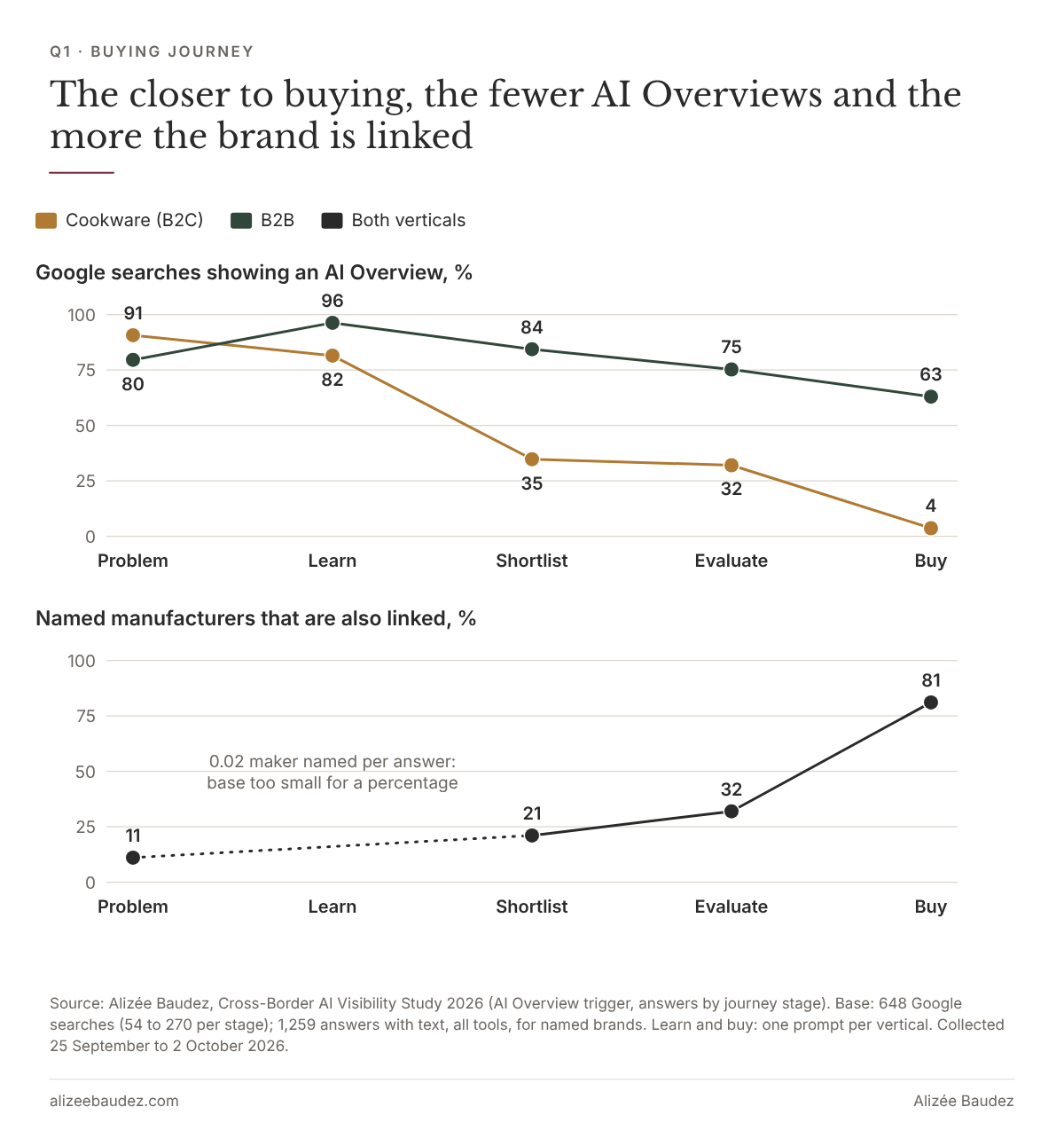
    Overall, 62.7% of Google searches show an AI Overview (406 of 648). In cookware, an AI Overview appears for 90.7% of problem searches ("my pans keep sticking") and for 3.7% of those where the buyer looks for where to buy. In B2B: 79.6% at the problem stage, 84.4% at shortlist, 63.0% at purchase.

    The nearer the buyer gets to purchase, the less the AI Overview appears and the more the brand is linked

    Source: Alizée Baudez, Cross-Border AI Visibility Study 2026 (AI Overview trigger rate, answers by stage of the buying journey). Base: 648 Google searches, from 54 to 270 depending on the stage; for the share of linked brands, answers from all three tools to the questions that name no brand. Learning and purchase: two questions each, one per sector. Collected 25 September to 2 October 2026.
    See the chart data
    StageCookware (B2C) (AI Overview)B2B (components) (AI Overview)Both sectors (AI Overview)Named manufacturers also linkedn (stage)
    Problem91%80%85%11%108
    Learning82%96%89%50%54
    Shortlist35%84%60%21%270
    Evaluation32%75%54%32%162
    Purchase4%63%33%81%54

    Reading. In cookware, the place where the buyer chooses is where the AI Overview steps back: Google sends people to its classic results. AI Overview visibility there is pre-purchase visibility. In B2B it stays present through to purchase.

    Caveat. The stages rest on few questions: one per sector for learning and for purchase. The drop at purchase is therefore first of all the gap between two questions.

    All cells: brand-site links cited by the three tools.

    FindingFor you

    ChatGPT cites language folders on a global domain

    Which URL structure do the tools cite for brand sites?

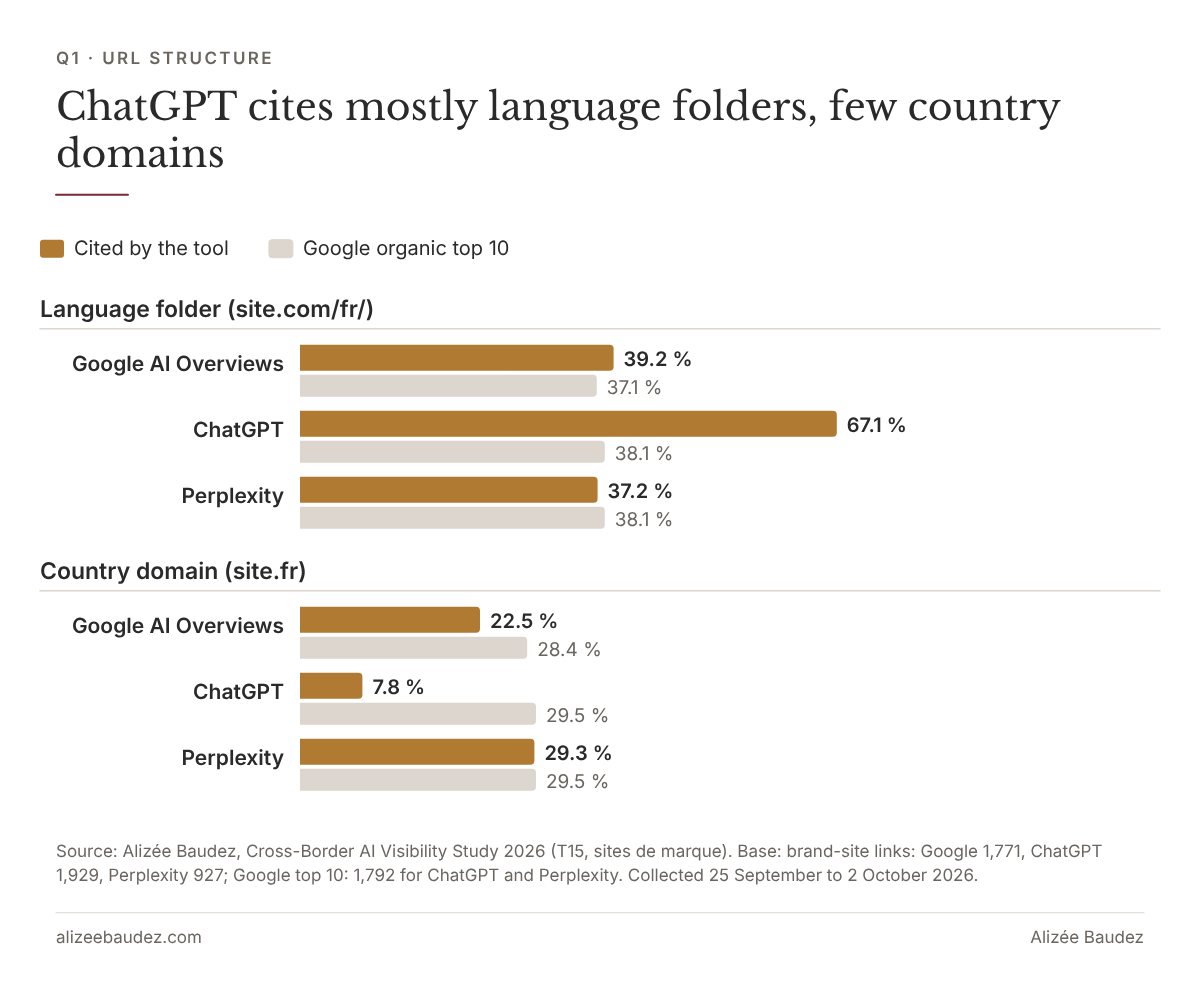
    ChatGPT cites country or language folders (for example se.com/fr/) in 67.1% of its brand-site links. Google’s top 10 has only 38.1%. ChatGPT cites fewer national domains (.fr, .de, .ch): 7.8% against 29.5%. Google and Perplexity stay close to their top 10 (39.2% and 37.2% of folders, against 37.1% and 38.1%). ChatGPT’s pattern holds in both sectors: 77.6% in cookware, 64.9% in B2B.

    ChatGPT mostly cites language folders, few national domains

    Source: Alizée Baudez, Cross-Border AI Visibility Study 2026 (URL structure, brand sites). Base: brand-site links cited: Google 1,771, ChatGPT 1,929, Perplexity 927; Google organic top 10: 1,792 links. Collected 25 September to 2 October 2026.
    See the chart data
    ToolLanguage or country folder (se.com/fr/): cited by the toolLanguage or country folder (se.com/fr/): Google top 10National domain (.fr, .de, .ch): cited by the toolNational domain (.fr, .de, .ch): Google top 10n
    Google AI Overviews39.2%37.1%22.5%28.4%694+
    ChatGPT67.1%38.1%7.8%29.5%1,294+
    Perplexity37.2%38.1%29.3%29.5%345+

    Reading. ChatGPT turns to a global domain with language folders rather than to national domains. This is an observed association, not a demonstrated effect: the data do not say that URL structure makes a site get cited.

    Caveat. ChatGPT’s 1,294 folder links rest on 40 domains, while ChatGPT cites 81 brand domains in all. Six of them carry 65% of these links (endress.com, se.com, siemens.com, hager.com, zwilling.com, sick.com): the finding mostly describes these large sites.

    French and German rows: questions asked in the brands’ home language.

    Vertical-specificFor you

    Brands are named for their language, clearly in B2B

    Are a country’s brands named more often when the question is asked in their language, or from their country?

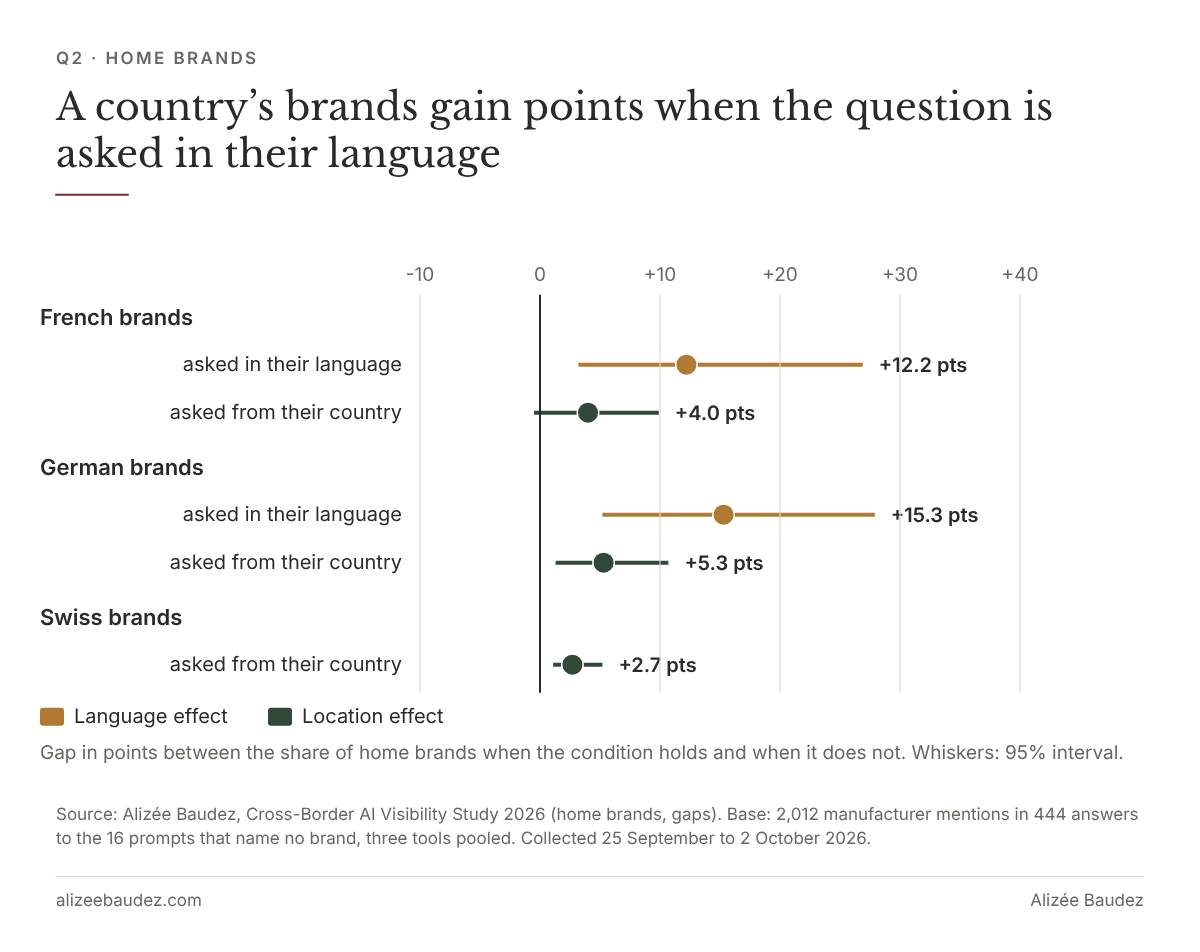
    Across the 16 questions that name no brand, the answers contain 2,012 manufacturer mentions. The share of French brands rises from 21.9% to 34.1% when the question is asked in French (12.2 points more). For German brands, from 35.1% to 50.4% in German. Location weighs less: from 2.7 to 5.3 points depending on the brands’ origin. The language effect is mostly a B2B effect: 16.5 points for German brands in German, 4.8 points for French brands in French. In cookware the gaps point the same way (19.1 and 12.7 points), but their intervals include zero.

    A country’s brands gain points when the question is asked in their language

    Source: Alizée Baudez, Cross-Border AI Visibility Study 2026 (brands of origin, gaps). Base: 2,012 manufacturer mentions in answers to the 16 questions that name no brand, three tools together. Gap in points between the share of home brands when the condition is met and when it is not. Whiskers: 95% interval; hollow dot: the interval includes zero. Collected 25 September to 2 October 2026.
    See the chart data
    Brands’ originGap, in their language (points), 95% intervalGap, from their country (points), 95% interval
    French brands+12.2 (3.2 to 26.9)+4.0 (−0.5 to 9.9)
    German brands+15.3 (5.2 to 27.9)+5.3 (1.3 to 10.7)
    Swiss brands–+2.7 (1.1 to 5.2)

    Reading. Manufacturers are named more often in their own language, clearly in B2B. Swiss brands gain little when the question is asked from Switzerland. One reading remains to be validated: having no language of their own, Swiss champions would build their authority in their neighbours’ languages.

    Caveat. Mentions come from a brand dictionary: a brand that is missing is not counted, and a mention is not a recommendation. 95% interval of the language gap for French brands: 3.2 to 26.9 points.

    Five hypotheses, two failures

    The five hypotheses were written before collection. Two of them fail, and the study keeps them.

    H1

    AI Overviews are the most localised tool

    Share of local domains among sources: ChatGPT 33.2%, Perplexity 18.8%, Google 18.1%.

    Not confirmed
    H2

    English answers bring up global sources everywhere, even from Zurich

    Share of global domains in English answers, by country: Google 80.8 to 84.4%, Perplexity 76.3 to 79.1%, ChatGPT 52.3 to 58.3%.

    Confirmedin part for ChatGPT
    H3

    Switzerland borrows its neighbours’ sources

    From Zurich, in German, Perplexity cites 75.3% German domains against 5.6% Swiss ones.

    Confirmedfor Google and Perplexity; mixed for ChatGPT
    H4

    B2B relies on distributors and directories, cookware on resellers and review media

    In B2B, manufacturers’ sites make 46.2% of Google’s stable citations, distributors and directories 23.8%.

    In part
    H5

    Champions are named more than linked, giants are both

    Champion: a brand with revenue under €5 billion; giant: €5 billion or more. Manufacturers named that are also linked: giants 27.4%, champions 25.8%.

    Not confirmed

    The full verdict on each hypothesis, with bases and intervals, is in part 7 of the full report.

    What becomes of the starting thesis

    The starting intuition was that a brand’s authority does not cross a border on its own. The data refine it rather than confirm it. On Google and Perplexity, authority travels from one country to another as long as the language stays the same, and does not travel from one language to another. On ChatGPT, the country matters too.

    For a company that sells on both sides of the Rhine, the consequence is concrete. For these tools, the German version of its site is not a translation of the French one. It is a presence on another market, facing other sources and often other competitors.

    What this changes for a champion

    A champion is a brand with revenue under €5 billion. Each recommendation rests on a result of this study. None promises traffic: the study does not measure any.

    Treat each language as a marketFor you

    What the results show. Two answers to the same question in two languages, from the same country, share only 0.08 of their sources on Google and 0.05 on Perplexity. In B2B, German brands gain 16.5 points of share of mentions when the question is asked in German, French brands 4.8 points in French.

    What they do not show
    That translating the site makes the brand appear in the target language. The study measures cited sources, not the effect of a piece of content.
    To check on your side
    In which language is your brand cited when the question is asked in each of your selling languages?

    What they do not show and what you can check on your side open with full access. Get the rest

    In B2B, check which version of your site is citedFor you

    What the results show. The manufacturer’s site is the first type of source in B2B (46% of Google’s stable citations, 79% of ChatGPT’s, 51% of Perplexity’s). Yet among links that point to a country version, the version for the tested country is cited in only 24% (Google), 26% (ChatGPT) and 22% (Perplexity) of cases. From Zurich, Perplexity cites the Swiss version in 7% of cases.

    What they do not show
    That the version cited is the "wrong" one. A Swiss customer sent to the French or German version may be served perfectly well.
    To check on your side
    When an AI tool cites your site, which page does it cite, in which language, for which country?

    What they do not show and what you can check on your side open with full access. Get the rest

    In cookware, authority is built with third partiesFor you

    What the results show. The brand’s own site makes up only 21% of ChatGPT’s stable citations, 19% of Google’s and 10% of Perplexity’s citations. The rest comes from media that test, sites that compare, forums and video.

    What they do not show
    That the brand site does not matter: when the brand is named in the question, its site comes back in a varying share of answers.
    To check on your side
    Which ten sites do the AI tools cite for your category, and what do they say about you?

    What they do not show and what you can check on your side open with full access. Get the rest

    For a Swiss company, play against the neighboursFor you

    What the results show. From Zurich, Perplexity cites 75.3% German domains against 5.6% Swiss ones in German. Google points the same way. Swiss brands gain little from being asked about from Switzerland (2.7 points, interval 1.1 to 5.2).

    What they do not show
    That Swiss content is useless. ChatGPT’s bases, the one tool that reads the country strongly, are small. The reading on Swiss champions is an interpretation of the figures.
    To check on your side
    Is your brand cited in French and in German on a par with the brands of France and Germany?

    What they do not show and what you can check on your side open with full access. Get the rest

    On Google, rankings firstFor you

    What the results show. 58% of AI Overview citations are on a domain in the organic top 10 of the same page, against 20% on ChatGPT and 21% on Perplexity. In cookware, the AI Overview appears for 91% of problem searches and 4% of purchase searches.

    What they do not show
    That ranking causes the citation. The association is observed, the cause is not; and more than half of AI Overview links are not in the top 10 down to the exact URL.
    To check on your side
    For your ten most important queries, which pages does Google rank, and which does the AI Overview cite?

    What they do not show and what you can check on your side open with full access. Get the rest

    Measure by tool, by language and by country, several timesFor you

    What the results show. The same test, repeated, shares only 0.45 of its domains on Google and 0.51 on ChatGPT, against 0.79 on Perplexity. Each of the three tools has its own logic: a single score adds them up.

    What they do not show
    That Perplexity is the most reliable to measure: it is the most consistent, but it refused nearly half of requests without an account.
    To check on your side
    Does your last AI visibility report distinguish the tool, the language, the country and the date?

    What they do not show and what you can check on your side open with full access. Get the rest

    Aim for the link, not only the nameFor you

    What the results show. About three named manufacturers in four are not linked (27% of giants and 26% of champions are). Being named in an answer does not mean the reader can click through to you.

    What they do not show
    That a link is a visit. The study measures whether a link exists, not whether it is used.
    To check on your side
    Of the answers that name you, what share carries a link to your site, and to which page?

    What they do not show and what you can check on your side open with full access. Get the rest

    Where AI tools sit in the buying journey

    Most conversions still happen in Google, and AI built into Google is the bigger part of the shift. Visibility in AI tools is one step in the buying journey, not an acquisition channel. The aim is not to promise traffic from ChatGPT. It is to know where you stand, market by market.

    Get the full study

    The seven findings stay open to everyone. Signing up opens everything else straight away, and the full report and the summary arrive by email.

    • The most-cited sites, by tool, language and country
    • Two set-ups side by side: shared sources and sources specific to each
    • 70 manufacturers, named and linked, set-up by set-up
    • The recommendations in full, with what they do not show and what you can check on your side
    Countries where you sell (optional)
    Languages of your site (optional)

    Your data is processed by MailerLite for Alizée Baudez. Details in the privacy policy.

    Full access is open.

    The explorer and the recommendations in full are open on this device. Your documents:

    A confirmation email is also waiting for you: confirm it to receive these documents in your inbox.

    The explorer: dig in yourself

    The story stops here. Pick a tool, a sector, a measure, and see what each of the nine set-ups gives. Every figure carries its base. Bases of fewer than 30 citations are marked with an asterisk.

    How the study was run

    The same 24 questions, in French, German and English, from France, Germany and Switzerland, put to Google AI Overviews, ChatGPT and Perplexity. Collected 25 September to 2 October 2026, logged out, with ProtonVPN set to Paris, Frankfurt and Zurich.

    Two sectors, twelve questions each: cookware (e-commerce) and electrical components and automation (industrial B2B). The questions follow the buying journey, based on the prompt-design method of Luca Fancello (Qwairy).

    1,510 answers analysed, 12,414 links cited. A citation is stable when the site appears in at least 2 of the 3 runs of the same test. Perplexity was run only once per test: its figures cover all its citations.

    Every figure carries its base. The 95% intervals resample the 24 questions. Site types were coded by AI agents, then reviewed by the author.

    Nine set-ups: three languages from three countries

    From France
    VPN Paris
    From Germany
    VPN Frankfurt
    From Switzerland
    VPN Zurich
    Question in French
    FR · fr216 tests
    DE · fr216 tests
    CH · fr216 tests
    Question in German
    FR · de216 tests
    DE · de216 tests
    CH · de216 tests
    Question in English
    FR · en216 tests
    DE · en216 tests
    CH · en216 tests

    A row: same language, three countries. Any gap comes from location. A column: same country, three languages. Any gap comes from language. English is the control: it is no one’s home language in these three countries.

    Each cell = 216 tests (24 prompts × 3 tools × 3 repeats).

    What the study does not say

    These limits apply to every result on this page.

    One week
    The data are a snapshot, 25 September to 2 October 2026. AI answers change from one week to the next.
    Logged out
    Every request was made without signing in. Someone signed in, with their history, may see something else.
    One city per country
    Paris, Frankfurt and Zurich stand for France, Germany and Switzerland. Geneva or Lausanne might give something else.
    One country, one day
    Each country was collected on a different day: for Google and ChatGPT, the effect of the country and the effect of the day cannot be separated.
    The same text in every country
    The questions are the same in each language, whatever the country. They do not reflect how each country would phrase its own question.
    24 questions
    Two sectors, twelve questions each. Results by stage of the journey rest on few questions: just one per sector for learning and for purchase.
    Automated collection
    A script asked the questions in fresh private sessions. Perplexity was run only once per test, and it refused nearly half of the requests without an account.
    Question language and browser language
    The browser language follows the question’s language: "language" means both together.
    Assisted coding
    Site types were coded by a first AI pass, reviewed by the author, with no second human coder. 6.8% of links are on low-confidence domains. Page types come from URL rules: read them as orders of magnitude.
    Association, not cause
    The results describe what the tools cite. They do not say why, nor what would get a site cited.
    No traffic measured
    The study measures whether a citation or a link exists, not the visits or sales it produces.

    How to cite this study

    Alizée Baudez, Cross-border AI visibility study: France, Germany and Switzerland, October 2026. alizeebaudez.com

    The prompt-design method draws on the recommendations of Luca Fancello (Qwairy).

    Alizée Baudez

    Who ran this study

    I’m Alizée Baudez, an independent international SEO and GEO consultant based in Strasbourg. I help companies that sell across borders to be visible in several markets at once, in Google and in AI answers.

    • 31clients supported since 2020
    • 11markets
    • 3working languages: French, English, German

    A method in three steps

    My method is called digital expatriation. You approach a new market the way you move abroad: culture first, data second, tools last. This study belongs to the second step, data, applied to AI answers.

    • 1. Culture first
    • 2. Data second
    • 3. Tools last
    • Lipton Teas & Infusions, Experience Abu Dhabi.
    • Speaker at Google Search Central Live, Barcelona, October 2026.
    • Teaches SEO at master’s level (M2) at EM Strasbourg.

    Find me online

    And for your brand?

    Multi-Market AI Visibility Sprint

    What this study showed for 24 questions, the Sprint does for your brand: your markets, your languages, your questions. It takes one week.

    • What AI tools say about your brand, market by market and language by language.
    • The sources they use, and who sits next to you.
    • The gaps between your markets, named and documented.
    • A prioritised action plan: content, entities and local authority.

    The goal is not to promise traffic from ChatGPT: most buyers still arrive through Google. It is to know where you stand, market by market, and what to do first. One briefing, one written deliverable, one debrief session. Implementation, content production and ongoing monitoring are not included.

    See the Sprint

    Talk about your markets

    It is not a sales call. It is a conversation to see whether the Sprint makes sense for you.

    Share this study

    Edit the text if you wish. The link opens the study.